“This is character-driven “Star Bait.” Barb Doyon, Extreme Screenwriting
Formerly known as Drop-In Squad.
ACCOLADES AS OF September 2026-
COVERFLY – RED LIST: Family Features, January 2025.
PITCH NOW: Features, 2025 Quarter Finalist
Contact: hester(dot)schell(at)gmail.com
Script Report: Recommend
Scriptapalooza: 2026 Quarterfinalist
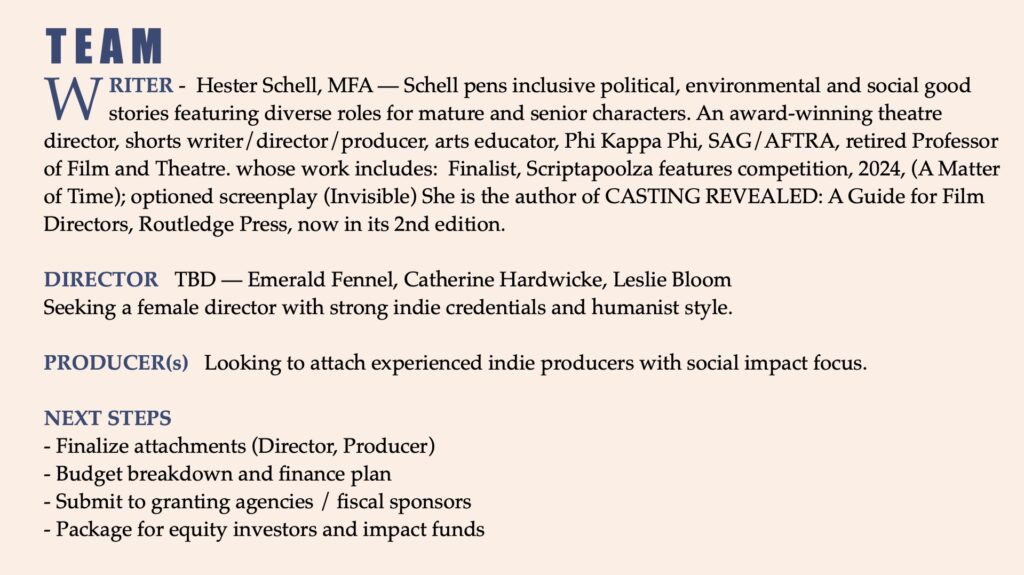
WRITER HIGHLIGHTS:
Scriptapalooza Finalist, 2024, (A Matter of Time).
Retired professor of Film and Theatre.
Author: Casting Revealed: A Guide for Film Directors, Routledge Press, London, 2017, 2nd edition; Michael Wiese Productions, 2011, Los Angeles, 1st edition.
Multiple short film festival award winner. Details upon request.
Graduate of American Academy of Dramatic Arts, New York, 1974.
Master of Fine Arts in Directing, 1991.
SAG/AFTRA, early career actor.
________________________________
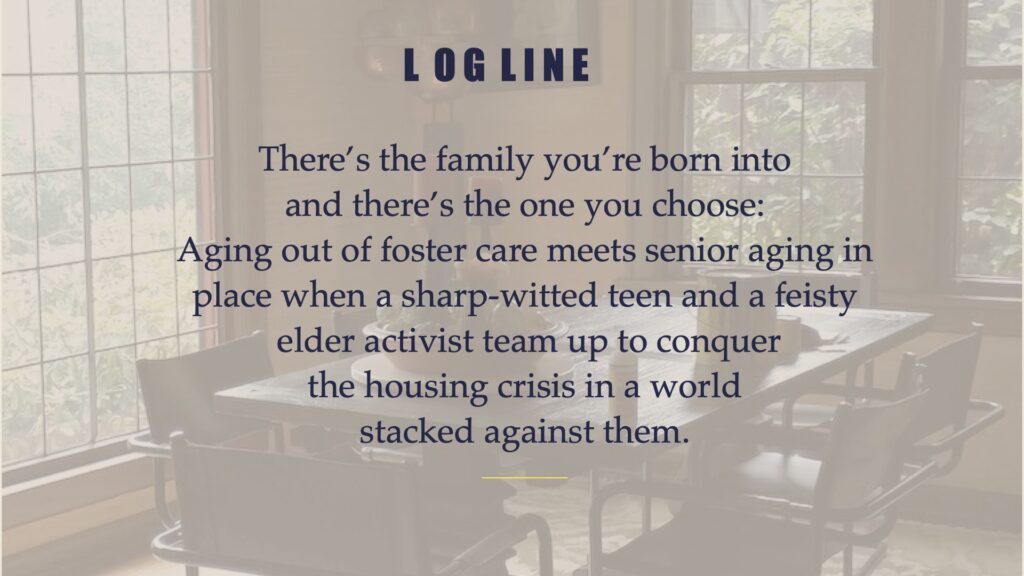
LOG LINE: There’s the family you’re born into and the one you choose: A teen growing up and an elder growing old forge new paths when aging out of foster care meets aging in place.
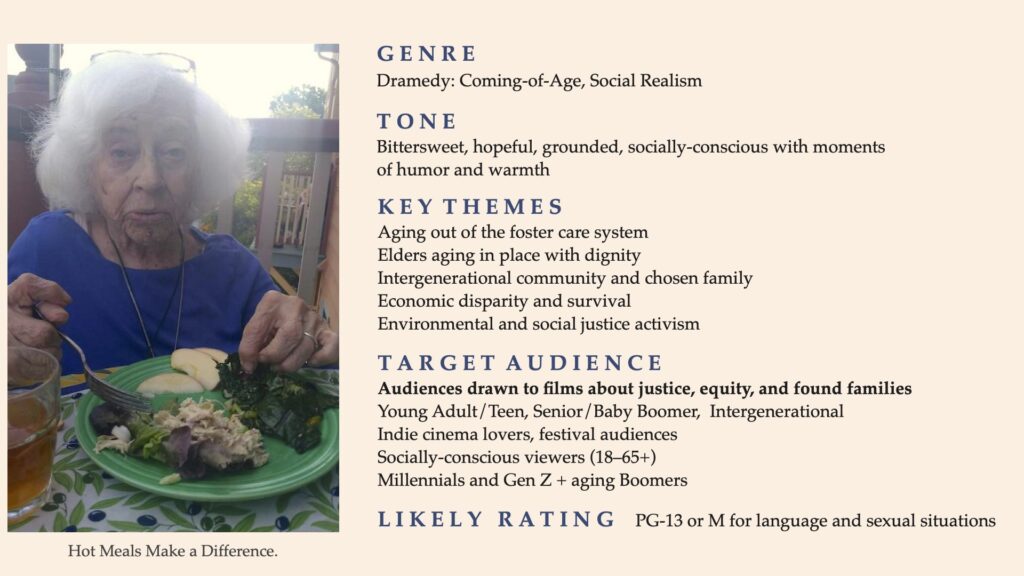
THEMES: A grounded, character-driven dramedy with moments of humor and warmth, Endless
Courage explores:
— Housing insecurity across generations
— Found family vs. systemic failure
— Youth resilience and entrepreneurial survival
— Aging, isolation, and dignity
— Activism as both personal and political
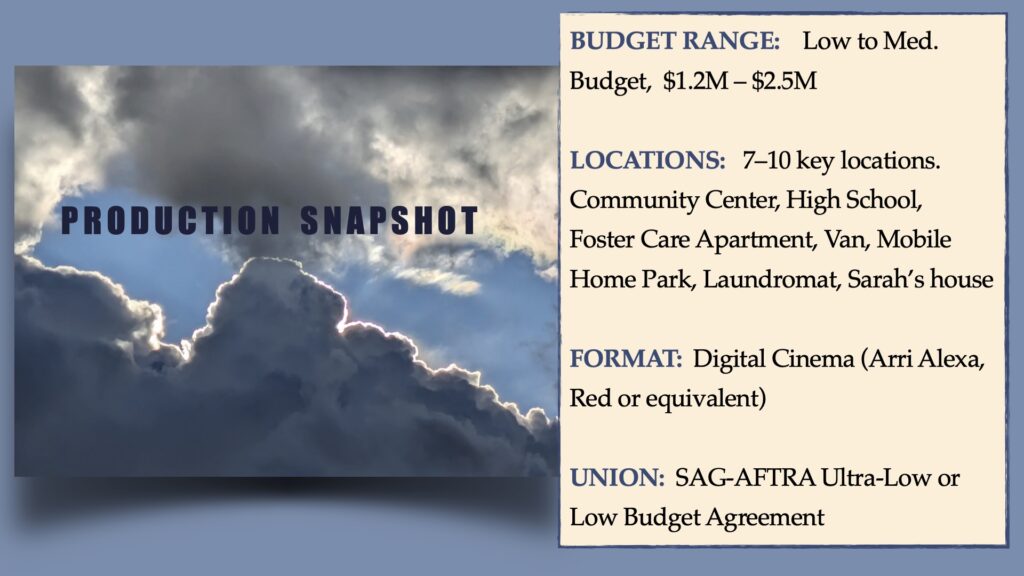
BUDGET TIER: Mid-Level Indie 2-10 Mil
Sweet Spot 3.5 – 5
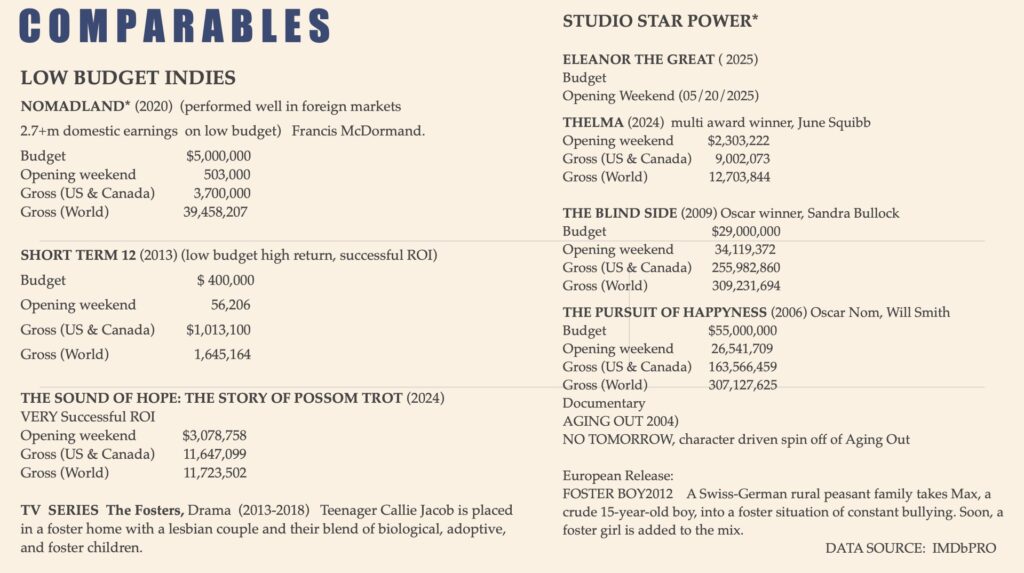
FINANCIAL & CONTENT COMP (1 A list actor, low budget, social issues drama)
Data Source: imdbpro.com)
NOMADLAND Oscar Winner
Francis McDormand. (2020)
2.7+m domestic earnings on low budget
Budget $5,000,000
Opening weekend 503,000Gross (US & Canada) 3,700,000
Gross (World) 39,458,207.
Worth Noting: Released during 1st year of pandemic and it still did extremely well.
Above average foreign markets.
CAST
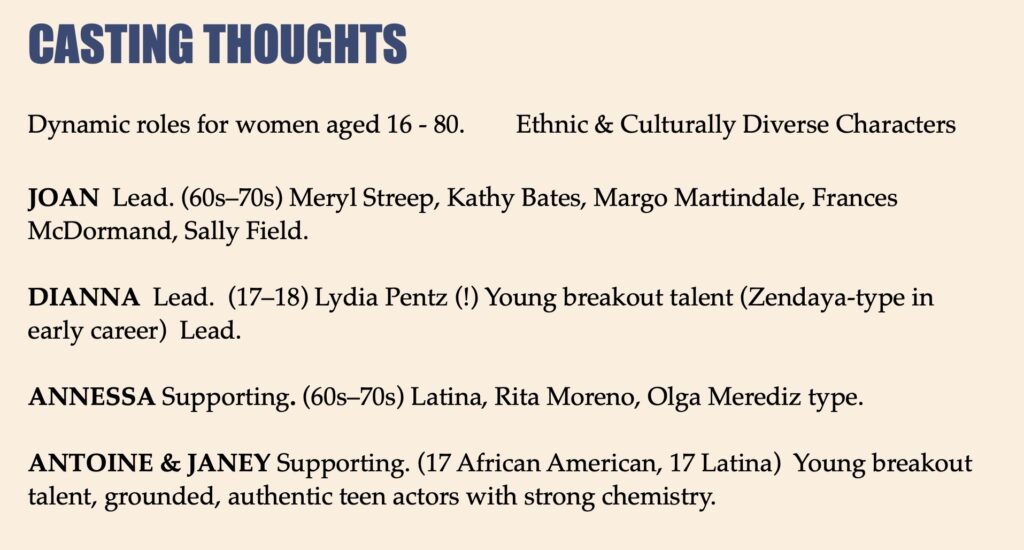
Tier A established lead, with budgets within Mid level indie $2-10 mil
Dynamic roles for women aged 16 – 80.
Ethnic & Culturally Diverse Characters
Tier B rising talent, $500K-$2M
Tier C character driven, concept driven, debut talent $100K -500K
DISTRIBUTION
Streaming, VOD, theatrical, hybrid or combination
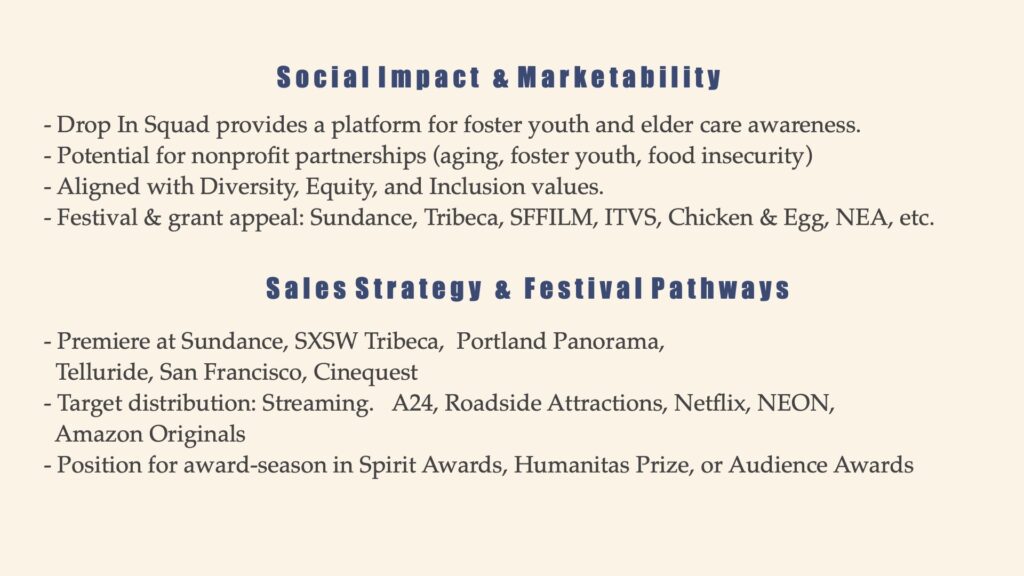
Premiere: Sundance, SXSW, Tribeca, Portland Panorama, Telluride, San Francisco, Cinequest
Target distribution: Streaming. A24, Roadside Attractions, Netflix, NEON, Amazon Originals
Position for award-season in Spirit Awards, Humanitas Prize, or Audience Awards
MARKET
YA & Seniors drawn to films about justice, equity, and found families
Young Adult/Teen, Senior/Baby Boomer, Intergenerational
Indie cinema lovers, festival audiences
Socially-conscious viewers (18–75+)
Millennials, Gen Z + Aging Boomers
SOCIAL IMPACT
Endless Courage provides a platform for foster youth and elder care awareness.
Potential for nonprofit partnerships (aging, foster youth, food insecurity)
Aligned with Diversity, Equity, and Inclusion values.
Festival & grant appeal: Sundance, Tribeca, SFFILM, ITVS, Chicken & Egg, NEA, etc.
LEAD CHARACTERS:
DIANNA, lead (17). Feisty, independent teenager sorting out her goals and aspirations. Sometimes frightened. Damaged by childhood trauma. Tenacious. Dependable. Needs stability. Entrepreneurial. Driven. Overwhelmed by the world and how she’s going to survive.
JOAN, lead (65 ) Senior single woman in her sixties. No family. Married to her work in giving back through community service. A leader, and visionary. Driving need to help others. Compassionate and doesn’t suffer fools. Motivated by civic action. Seeks justice and equality for under represented communities, in her case, senior citizens. Strong social justice motivation.
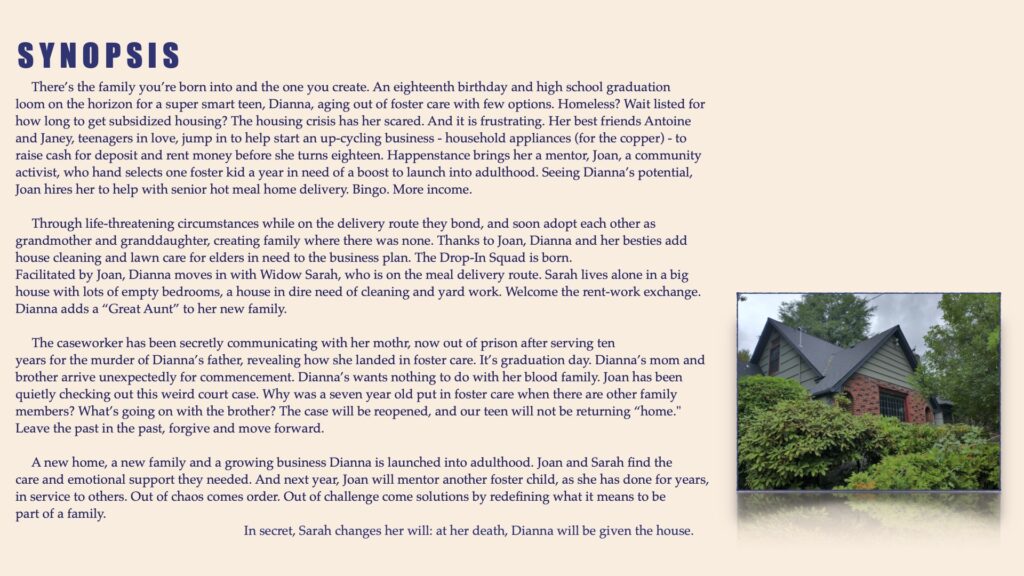
STORY: In late spring Portland, seventeen-year-old Dianna navigates the final weeks before aging out of foster care, her life a careful balance of survival and ambition. She runs a resale business with her closest friends—Janey, a sixteen-year-old Latina girl, and Antoine, her seventeen-year-old African American boyfriend—buying and flipping used electronics and appliances. Their entrepreneurial hustle earns them cash but also draws unwanted attention, with Antoine called to the principal’s office on suspicion of drug dealing simply because he is black.
Dianna’s world is marked by impermanence: a new foster child has already toured her room before she has moved out, and her cold foster mother Mimu makes it clear she cannot wait for Dianna’s eighteenth birthday to arrive. Dianna’s calendar counts down to two critical dates: graduation on June 9 and her mandate for move-out by June 30. The pressure manifests in silent screams into her mattress and obsessive apartment hunting that reveals an impossible housing market. She stands in endless lines in the rain, only to abandon them when she sees mothers with children who need housing more desperately. Her caseworker Helen, a compassionate trans woman, provides what support she can—food cards, bus passes, and warnings about subsidized housing wait lists stretching two to five years. When Helen mentions a small housing lead, Dianna tours a cramped studio for sixteen hundred dollars and rejects it as inadequate. The weight of potential homelessness presses dow on her constantly, a fear she sees reflected in every tent and every desperate face on Portland’ streets. Into this precarious existence comes Joan, a sixty-five-year-old activist who delivers meals to isolated seniors through the Food For All program. Joan and Dianna meet by chance during one of Joan’s activist activities. Joan invites Dianna and her friends to the community center, offering to pay them for their work. Later, Joan picks up Dianna walking drenched in torrential rain and immediately offers her a job delivering meals at twenty dollars an hour. During their routes together, Dianna discovers the harsh realities of elder poverty—residents like Julie Myers, who announces her suicide in a letter read aloud at a contentious mobile home park meeting where lease rates have doubled in five years. The trauma of witnessing Julie’s final act shakes Dianna deeply, triggering her own fears about housing insecurity. When she expresses despair that no one cares what happens to her, Joan grows angry at this self-pity, pulls over, and orders Dianna out of the van in the rain, refusing to tolerate wallowing when surrounded by options for solutions.
Their relationship deepens through honesty and confrontation. Joan discovers Dianna has been lying about her past—her parents did not die in a car accident. The truth is far more devastating: Dianna’s brother sexually assaulted her, and when her father discovered this, her mother shot him during the violent confrontation that followed, then took legal responsibility to keep the brother out of prison. Joan demands Dianna never lie to her again, then reveals she has chosen Dianna as this year’s recipient of the brass ring—her annual selection of one at-risk teen to mentor. Joan presents Dianna with Eleanor Roosevelt’s autobiography and shares stories of her own activist past helping draft dodgers escape to Canada during the Vietnam war. She introduces Dianna to feminist writers and teaches her that building community is what they do, that food is the bridge.
Joan develops a business plan called the Drop-In Squad, offering free services to seniors in the food program—weekly cleaning, laundry help, lawn and garden work, garbage collection. Dianna, Antoine, and Janey eagerly take on this work, finding purpose beyond profit. At Sarah’s house, they transform overgrown yards and clean neglected spaces while Sarah, a ninety-year- old woman who attended Woodstock, watches hummingbirds dance around her feeders. Sarah and Dianna discover they share the same birthday—Sarah will turn ninety-one on July fourth, and Dianna will turn eighteen. Violence shatters their growing stability when Joan is shot in a drive-by shooting outside Sarah’s house. Dianna desperately applies pressure to stop the bleeding, her clothes soaked in Joan’s blood. At the hospital, she reads Eleanor Roosevelt quotes to Joan, and they share an emotional moment where Joan calls Dianna her granddaughter and Dianna reciprocates, settling on calling Joan ‘Queenie’ to match their pattern of nicknames—Lady Di, Lady Jane, and Count Tony. Through tears and laughter, they declare their chosen family bond.
Sarah offers her home to both Joan and Dianna during Joan’s recovery. Helen facilitates Dianna’s move from the public housing complex, and suddenly Dianna finds herself in a beautiful old house with vaulted ceilings and vintage treasures. That first night, her hands automatically reach for door bolts before she realizes there is no lock needed. She explores her new closet filled with Sarah’s 1960s mod dresses and go-go boots, takes selfies in the vintage clothes, and falls asleep with moonlight streaming through the windows. At a celebratory breakfast, Sarah shares her philosophy: special items should be enjoyed rather than saved for occasions that may never come. She insists on using her grandmother’s precious strawberry jam dish and encourages Dianna to wear the go-go boots from Woodstock.
Dianna’s graduation brings confrontation when her brother Donovan and mother Cheryl Anne appear uninvited. Dianna coldly rejects their attempts at reconciliation, declaring the event sold out. But Joan later delivers difficult wisdom: to move forward, Dianna must forgive her mother. At a tense diner meeting arranged by Joan, Dianna delivers a comprehensive forgiveness, acknowledging that law enforcement did not believe women and courts did not believe in self-defense. Joan then reveals that Cheryl Anne’s case has been re-opened. Daniel, Joan’s former mentee who now runs a patient transport business, becomes another brother figure to Dianna, sharing his own foster care story and offering wisdom about trauma—that telling their stories keeps the pain in the distant past, though it requires endless courage.
Sarah completes the ultimate act of chosen family: she signs legal documents making Dianna the owner of her house upon her death. At Oaks Park carousel, the extended family celebrates — Sarah, Joan, Annessa, Daniel, Antoine, Janey, and Dianna—reaching for brass rings as the carousel turns, then breaking into an elaborate dance that captures the spirit of Portland itself, a community built not on blood but on care, activism, and the radical act of showing up for one another.
Pitch Deck